

Pilot Briefing
ICAO Code: EGBO | Frequency: 123.005

FLYING INTO HALFPENNY GREEN HAS NEVER BEEN EASIER
Wolverhampton Halfpenny Green Airport (EGBO) is designed with pilots in mind. Our refurbished runways and taxiways, modern facilities, and our new bar and restaurant will make your visit enjoyable. With online booking and payment options available, planning your trip is simple.
This briefing page provides everything you need – key information, procedures, facilities, and contacts – to ensure a smooth, stress-free experience.
The pilot briefing is split into three key sections:
-
- Aerodrome Information
- Aerodrome Procedures
- Additional Information
Aerodrome Information
Last updated 8th December 2025
Licensed Aerodrome Hours
Licensed Hours
- Summer: 0900 – 1800 (Local Time)
- Winter: 0900 – 1700 (Local Time)
If you require an extension to normal hours, please refer to our fees page. To book in a watch extension, contact Air Traffic Services. Watch extensions must be approved by airport management first.
Note: Any aerodrome closures or changes to licensed hours, for example changes to operating hours during the Christmas period, will be promulgated via a NOTAM.
Air Traffic Services
Wolverhampton Halfpenny Green Airport primarily operates an Aerodrome Flight Information Service (AFIS), however, at times we may operate a temporary Air Ground Communication Service.
Frequency: 123.005 MHz (VHF)
Callsign:
- ‘Halfpenny Green Information‘, when operating an Aerodrome Flight Information Service
- ‘Halfpenny Green Radio‘, when operating a temporary Air Ground Communication Service
Rescue and Fire Fighting Services
Wolverhampton Halfpenny Green Airport has onsite Rescue and Fire Fighting Services, using a RFF Category A2 compliant vehicle.
RFFS operates as per the aerodrome’s licensed hours, unless a NOTAM states otherwise.
RFF Category
- Monday – Friday RFF: Category A2 (Category A3 available on remission, with advanced notice and acceptance)
- Saturday – Sunday: RFF Category A1 (Category A2 available on remission, with advanced notice and acceptance)
Aerodrome Administration
Wolverhampton Halfpenny Green Airport is operated and managed by the licence holder, Wolverhampton Airport Ltd. We are a licensed aerodrome and also an Air Navigation Service Provider (ANSP).
The aerodrome has an established Safety Management System and numerous internal operating procedures. The accountable manager at Wolverhampton Halfpenny Green Airport is the Airport Operations Manager.
The aerodrome has a safety committee which discusses and liaises with the aerodrome management on issues relating to operations and safety. The aerodrome also has has an airport user group, which allows airport users to consider, discuss and promulgate safety issues relating to the airport. More information can be found here: Airport User Group.
During published operational hours, the Airport Operations Manager or the Airport Duty Manager is responsible for day-to-day operations and has overall control of the aerodrome site. This includes making decisions which may impact aerodrome operations.
Nominated individuals, including the accountable manager, has the authority to grant, refuse or restrict permission for any aircraft movement, with consideration to safety, weather, noise, surface conditions or on behalf of the company for administrative/financial reasons.
Additional Aerodrome Notices & Procedures (OPNOT / SI / TOI / NOTAM)
Supplementary Instructions (SI) & Temporary Operating Procedures
SIs and TOIs introduce permanent or temporary changes to standard operating procedures, directly impacting operational manuals at Wolverhampton Halfpenny Green Airport.
While most SIs and TOIs are internal, some may affect pilots and flight planning. Any changes that impact pilots will be published on our website to ensure you have the latest information before your flight.
Current SIs & TOIs can be found here: SIs and TOIs
Operational Notice (OPNOT)
OPNOTs provide important operational updates that do not change standard operating procedures but may affect your flight planning. These notices can include information about events, maintenance work, or temporary changes such as airside operating hours.
Current OPNOTs can be found here: OPNOTs
Notice to Aviation (NOTAM)
NOTAMs provide critical, time-sensitive information that may affect flight safety and planning. These notices include details such as temporary runway closures, airspace restrictions, or changes to navigation aids.
At Wolverhampton Halfpenny Green Airport, NOTAMs are regularly used to promulgate temporary changes in the Aeronautical Information Publication (AIP).
Pilots are responsible for checking all relevant NOTAMs before departure to ensure compliance and safety.
Current NOTAMs can be found on SkyDemon or on the NATS website.
Guidance on NOTAMs can be found here: NATS UK | NOTAM Guidance Material
PPR - Booking In and Booking Out
Wolverhampton Halfpenny Green Airport is a PPR aerodrome. Visitors are required to book in before flying into the aerodrome.
Book In (PPR)
PPR is now available online. To book in online, click here.
Alternatively, you can contact ATS directly to book in. To do this, call them on 01384 221378 (for imminent bookings) or email atc@wolverhamptonairport.co.uk (for bookings in over 2 hours).
Book Out
Aircraft wishing to depart the aerodrome are required to book out before requesting taxi. Failing to do so will result in delays, as air traffic are required to process your details first before allowing taxi.
If you have already submitted a PPR request to fly into Halfpenny Green and you are now ready to depart, you do not need to book out using the below form. Air traffic already have your details. If your details have changed, please contact the air traffic team directly by ringing 01384 221378.
Book out is now available online. To book out online, click here.
Alternatively, you can contact ATS directly to book out. To do this, call them on 01384 221378 (for imminent bookings) or email atc@wolverhamptonairport.co.uk (for bookings in over 2 hours).
Runway Information
All runways and taxiways at Wolverhampton Halfpenny Green Airport have a Maximum Takeoff Weight (MTOW) of 12 tonnes.
Runway Information
| Runway | TORA | TODA | ASDA | LDA |
| 16
34 |
1025
1096 |
1025
1096 |
1064
1096 |
858
910 |
| 10
28 |
799
799 |
799
799 |
799
799 |
799
|
| 04
22 |
646
515 |
646
515 |
646
515 |
515
616 |
Runway 16/34 has a width of 30m.
Runway 10/28 and 22/04 have a width of 18m.
Grass Runway
Grass runway 10/28 is unlicensed. It may not be used by traffic requiring a licensed runway.
Length 350m.
Width 18m.
Runway Selection
Air Traffic will select a runway in use giving regard to surface wind, ground conditions and operational requirements. Pilots may request the use of an alternative runway where available.
Pilots flying outside of the aerodrome’s licensed hours must do so in accordance with the After Hours Flying procedures.
Aerodrome Procedures
Last updated 23rd November 2025
Taxi Procedures
The movement of aircraft, persons or vehicles are subject to permission from the Duty FISO. When operating temporary AGCS, pilots must still inform ATS of their intentions to taxi before doing so.
Pilots must taxi with caution near the Fuel Bay and in the area adjacent to the tower where there is a marked pedestrian crossing, due to pedestrians possibly manoeuvring on the taxiway. Taxi speeds should not exceed a fast walking pace.
Taxiing in or out of hangars is strictly forbidden.
When the grass runway becomes active, taxiing aircraft to runway 10/28 are to be held at Holding Point A3 or A5, or north of the intersections, until no conflict exists.
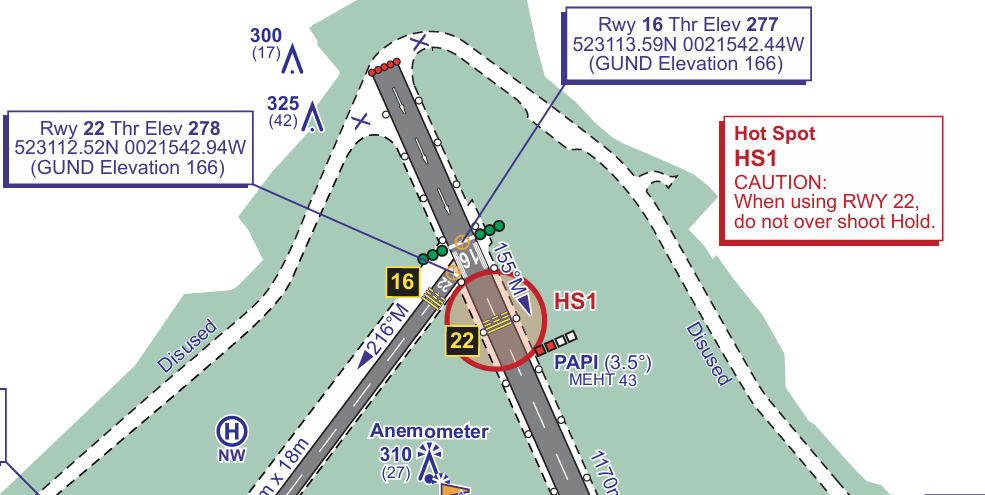
Runway 22 Hotspot
A hot spot has been identified at the runway holding point position for runway 22, located on runway 34. This is due to the risk of over running the holding point resulting in a runway incursion.
Aircraft taxiing to the runway 22 holding point should do so with increased caution when entering runway 34. The holding point is not always visible until short notice.
Joining Procedures
Fixed wing traffic joining should do so by a standard overhead join at 2,000ft AGL (QFE).
Aircraft wishing to join on downwind, base leg, or final must ensure the FISO / AGCS Operator is informed prior to entering the ATZ.
Aircraft descending in the overhead must not descend below 1,300ft deadside – due to the active rotary circuit.
Circuit Procedures
Circuit Procedures
Fixed Wing:
- Left hand for all runways
- 1,000ft AGL (QFE)
Rotary:
- Right hand for all runways
- 800ft AGL (QFE)
Orbits are not permitted within the circuit.
In the event that the circuit is busy, pilots should exercise judgement about the best appropriate action. This includes, but limited to:
- Operating the aircraft at a slower safer cruising speed, to allow for better traffic separation
- Go around and reposition within the circuit, keeping air traffic informed of intentions
- Climbing into the overhead and rejoining the circuit, keeping air traffic informed of intentions
- Vacating the circuit and rejoining the ATZ when traffic levels subsequently reduce
Precautionary / Bad Weather Circuits
Precautionary / bad weather circuits are permitted when traffic levels permit. When traffic levels are high, the Duty FISO may request for PICs not to fly precautionary circuits.
Precautionary circuits should be flown at 600ft AGL (QFE).
Practiced Forced Landings
PFLs may be conducted overhead the airfield as long as the FISO has been informed prior to initial positioning for and prior to the commencement of the manoeuvre.
Where traffic volumes are high, the Duty FISO may request in the interest of safety that a PFL does not commence / is terminated.
Practice Engine Failures After Takeoff
EFATOs must inform Air Traffic Services on the VHF during commencement by using the standard phrase ‘Fanstop’.
On runway 34, no EFATOs are permitted until passed Whittimere Farm (523149.1016N 0021551.696W), 1000 M beyond the end of the runway.
Noise Abatement Procedures
Runway 16
All departure at the airfield boundary should make a track change of 10 degrees to the right. No left turns are to be made below 600ft QFE. No direct overflights of Highgate Farm (523030.132N 0021457.5268W) are permitted.
Runway 34
No FANSTOP (practice engine failure after take-off) are permitted until passed Whittimere Farm (523149.1016N 0021551.696W), 1000 M beyond the end of the runway. Traffic turning left into the visual circuit are to avoid direct overflights of Claverley (523214.4204N 0021811.9592W) and Bobbington Village (523043.848N 00216 58.116W)
Runway 10/28
Departures, approaches, and visual circuits are to avoid direct overflights of Bobbington Village and Primary School (523043.848N 002 658.116W).
The Aerodrome Geographical & Administrative Data can be found on the NATS AIS website.
Aerobatic Flights
Aerobatics in the overhead are to be requested in advance of the flight and should only take place providing there is a minimum cloud base of 4000ft QFE with no manoeuvres below 3000ft QFE and a minimum visibility of 8km.
It is the responsibility of the Pilot in Command to ensure this criteria is being complied with and it meets the requirements of their own SOP’s.
Two way communication with ATS on 123.005 is to be maintained at all times.
No aerobatics in the overhead are to commence in the event of a first solo flight and are to stop in the event of an
aircraft emergency being called.
Formation Flights
Formation departures from the runway are permitted providing the following procedures are
followed:
- All departures are to be fully briefed by the aircraft operator / pilot in command and notified in
advance via PPR. - No formation take-offs from the grass strip.
- One of the pilots in command will be designated and notified as the flight leader.
- Flights must use a formation callsign and follow the requirements as laid down in SERA.3135 in regard separation, navigation and position reporting.
Formation departures must follow standard departure, circuit and noise abatement profiles. - Formation approaches to the airfield are to follow standard profiles and are not permitted below 500ft QFE.
- Formation landings are not permitted.
Operators intending to undertake formation take-offs are to provide in advance to the Aerodrome Operator a detailed procedure document covering there pre – briefing, limitations and emergency procedure(s). Written confirmation that their insurance covers formation take offs and flying is to be provided in writing to the Operations Manager.
Airways Joins (IFR Traffic) Procedures
South:
IFR Airways traffic departing to the south should file a flight plan direct to CPT VOR. Flight plans should not be filed for HON VOR due to commercial traffic volumes.
When ready to taxi, request for an airways join from ATS and await further instructions.
North/East/West:
File flight plan as normal using preferred reporting points.
When ready to taxi, request for an airways join from ATS and await further instructions.
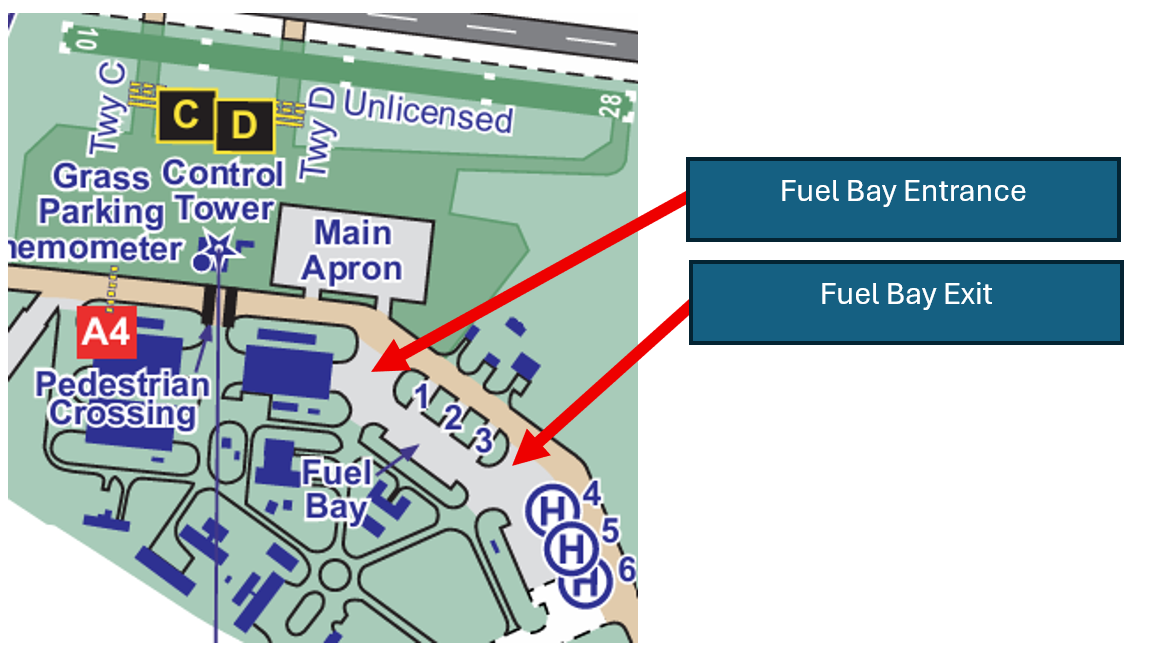
Entering & Exiting Fuelbay Procedures
The Fuel Bay operates a one-way system, entry at the west end (near Hangar 3 east), exit at east (near the mobile fuel bowser). Aircraft to draw up with pumps on starboard side.
JET A1 and AVGAS are self service pumps.
For assistance with refuelling, alert air traffic who can deploy the Fire Crew.
Rotors Running Refuels Procedures
Rotors Running Refuels (RRR) are permitted at Wolverhampton Halfpenny Green Airport.
Hours of Service
RRR is published as available Monday – Friday 09:00 – 16:45, unless a NOTAM states otherwise.
RRR can be facilitated outside these hours with advanced notice. To request RRR outside of these hours, contact Air Traffic Services providing at least 24 hours notice.
RRR outside aerodrome hours will incur additional watch extension fees. These fees can be found on the Aircraft & Fuel Fees page.
Types of Helicopters Accepted
Please note, not all types of helicopters are eligible for RRR. These include helicopters with low skids or rotor blades.
Air traffic will usually enquire about helicopter details before accepting any RRR bookings.
Refuellers have the right to reject RRR refuels and can request for a shutdown refuel instead last minute, should they deem the helicopter as unsafe for RRR.
Procedures
Air Traffic Services will request for the amount of fuel you require in litres before any RRR takes place. This will likely be requested over the VHF when you are inbound, and ATS will pass this information onto the Refuellers.
ATS will assign a helipad, usually helipad 4, for the RRR to take place.
During RRR, the pilot in command must not leave the helicopter under any circumstances. By doing so, the RRR will be terminated immediately.
Emergencies
In the event of an aerodrome emergency or an emergency involving the helicopter, the RRR will terminate immediately.
The helicopter will be instructed by ATS to shut down its engines and electrical systems.
Pilot Controlled Lighting Procedures
Pilot controlled lighting will become available to use in early 2026.
Out of Hours Flying Procedures
Pilots wishing to use the airport outside of published hours must complete an Out of Hours Permit, return the permit to Air Traffic Services, and receive a permit number before flying outside licensed hours. Pilots must follow published conditions. More information can be found on the After Hours Flying page.
On completion of a flight, the pilot must complete an Aircraft Movement Log. This should be carried out within 24 hours of the flight.
Emergency Procedures
Radio Failure
In the event of RTF failure whilst within the circuit, pilots should continue to make a full-stop landing. A lookout for light signals should be made. Blind position reports should be made.
In the event of an RTF failure whilst away from the circuit, but where the flight intended to return to the aerodrome, select transponder code 7600 and make an overhead join. Observe the signal square and other aircraft and proceed to join the circuit to land. A lookout for light signals and blind position reports should be made.
Other Emergencies
Inform the Duty FISO at the earliest opportunity, where appropriate pre-fix with a standard Pan Pan or Mayday call. The FISO will offer assistance as appropriate.
Additional Information
Last updated 14th December 2025
Paying Landing Fees
Fees can be paid in the airport office or online – click here to pay online. Landing fees can only be paid online when the airport office is closed.
All charges must be paid in full prior to departure from the airfield. If the operations team has to chase for a late payment, it will incur an administration charge of £25.00.
Operators that wish to be invoiced should contact the office in advance, where a member of the finance team will assist – click here.
Fees
For more information about our fees, please click here.
Fuel
AVGAS and Jet A1 F35 are available from the self service pumps.
F34 is also available from the mobile refuelling bowser.
F34 rotors running refuels available upon request.
For more information about our fuel fees, please click here.
Night Flying
Night flying starts on the first Thursday after the clocks go back (changing timezones to GMT) to the last Thursday before the clocks go forward (changing timezones to BST).
Night flying for the 2025 season starts on the 30th of October 2025 and will run until March 2026.
For more information, please click here.
Submit a General Aviation Report
Air Traffic Services are no longer permitted to accept or process email / paper / FAX GARs due to changes in regulation.
You can use now use the online ‘Submit a GAR’ service from Border Force. To use the service, click here.
After submitting a GAR via the gov.uk website, it is recommended you email a PDF version to Air Traffic Services – in case Border Force contact them.
Live Weather
Keep an eye on the latest conditions at Wolverhampton Airport with our live weather feed. Updated in real time, this tool provides accurate data on wind speed, direction, temperature, and visibility to help you plan your flight safely and efficiently. Whether you’re preparing for arrival, departure, or training, the live forecast ensures you’re always one step ahead of the weather.
Amelia's Bar & Restaurant
Open 9am – 5pm, 7 days a week.
